| 

|
How did this 1886 light
opera manage to become so popular that its box
office profits were sufficient to build a new London
theatre, The Lyric of Shaftesbury Avenue? When
launched at the Gaiety Theatre the comedy opera
initially received only a lukewarm reception and
gave little indication of any long-standing success.
A wily accountant and
theatre manager, Henry Leslie bought the musical's
rights and costumes at low cost and relaunched the
piece at the Prince of Wales Theatre with Ben Davies
as Wilder, Hayden Coffin as Sherwood and Furneaux
Cook as Bantam. Marie Tempest later replaced Marion
Hood in the title role. The recipe of this excellent
cast soon brought good box office receipts and
helped it achieve a successful 931 performances and
see off the Mikado's 672 and Ruddigore's
288 performances during its run. We need to further
understand the secret for this.
The music of Dorothy
contains good variety in its construction and
includes both dances and a ballet. The critics
referred to the show as 'pretty', 'graceful', and
'charming'. Cellier's orchestration is certainly
bright, rich and varied, and he skillfully links
sections within a number to maintain momentum. To
aid diction, the accompaniment to verses is light as
with Sullivan and carries echoes of the music hall,
then in vogue, in the chorus numbers. We find that
the chorus parts are well scored with up to five
parts of harmony, as befitting a composer schooled
at the Chapel Royal.
|
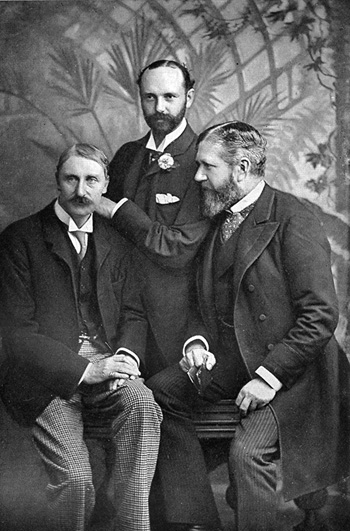
Cellier, Leslie, Stephenson
|
|
Stephenson's book has
weaknesses but they are covered by the strong
characters of Wilder, Sherwood, Dorothy and Lydia
who hold interest with their amorous and mischievous behaviour. Comedy is introduced by a scruffy
Sheriff's officer (Lurcher) in his wooing to an
upper crust Mrs. Privett (her speech affliction
complementing his dropped aitches). Their
interaction with Squire Bantam leads to effectively
embarrassing moments with double-entendres adding
much amusement. Such larger than life characters
could have been taken out of a Victorian Drury Lane
pantomime. During the early weeks of the run the
script was tightened and much improved to overcome
the concerns of the first night critics.
|
|
For Cellier's revision,
he chose librettist B C Stephenson who had written
Sullivan's The Zoo in 1875 (under the pen name,
Bolton Rowe). For Dorothy, Stephenson was
handicapped by needing to fit new lyrics to Cellier's existing music. This is never an easy task
as W S Gilbert once found out. It can explain why
some of Dorothy's lyrics seem uninspired in
construction. Where songs were freshly composed,
Stephenson fairs better. He provides well written
and believable dialogue throughout. An interpolated
number for Hayden Coffin (as Sherwood) was "Queen of
my Heart". This was an early Cellier & Stephenson
romance known as "Old Dreams", and given new words.
It was introduced after the first night and became
one of Dorothy's hit songs that became widely known
from first a Polyphon disc (1890s), then on a
pianola roll of Dorothy selections of c.1905, then
from 78 records of Beka Grand (c.1915) Zonophone
(1931) and by George Baker on Decca, then heard with
full orchestra for the first time c.1933.
The fact that this
musical became such a success seems more amazing
when one finds that Cellier originally composed its
music for an earlier operetta, Nell Gwynne
(1876). When Nell Gwynne was originally staged in
Manchester at the Princes Theatre it was deemed a
failure when it achieved only 24 performances. The
composer blamed the librettist, H. B. Farnie, and
the librettist blamed the composer. Although some of
the songs had been published they decided to buy
back their material from the publisher Metzler and
go their separate ways and not to risk taking it to
London.
|

Marie Tempest
|
|
The book and music was
remodelled with different partners. Both of the
revised shows faired better, but Nell Gwynne
only achieved 86 performances while Cellier's
Dorothy played and played. For Cellier's
revision, he chose librettist B C Stephenson who had
written Sullivan's The Zoo in 1875 (under
the pen name, Bolton Rowe).
For Dorothy,
Stephenson was handicapped by needing to fit new
lyrics to Cellier's existing music. This is never an
easy task as W S Gilbert once found out. It can
explain why some of Dorothy's lyrics seem uninspired
in construction. Where songs were freshly composed,
Stephenson fairs better. He provides well written
and believable dialogue throughout. An interpolated
number for Hayden Coffin (as Sherwood) was "Queen of
my Heart". This was an early Cellier & Stephenson
romance known as "Old Dreams", and given new words.
It was introduced after the first night and became
one of Dorothy's hit songs that became widely known
from first a Polyphon disc (1890s), then on a
pianola roll of Dorothy selections of c.1905, then
from 78 records of Beka Grand (c.1915) Zonophone
(1931) and by George Baker on Decca, then heard with
full orchestra for the first time c.1933.
One is conscious of a
rustic, idyllic innocence in the melodies and
rhythms that conjure up thoughts of a 'Constable'
backdrop such as could be found sixteen years later
in Edward German's light rustic opera, Merrie
England. Selections from the show became a
feature of the Henry Wood London Promenade Concerts
in 1895 and the following year. The comic opera
toured on three continents before becoming popular
with amateur operatic societies round the world.
|
|
